Mentally Constipated? Take A Dump.

I’ve been doing a ton of decluttering these past few weeks. My spaces but more importantly, my mind.

It’s the beginning of my physical and mental processes to get ready to do goals work. If I don’t declutter first, I overextend myself. Too many goals, too many areas of life, too many steps to achieve them. I’m a high achiever and it’s a strength I value in myself. I am also an overthinker. Big time. I just spent two minutes trying to find a ‘better’ way to say big time. Is that enough proof for you?

Read more: Mentally Constipated? Take A Dump.

I also have a process for before the decluttering begins (there’s more proof). A big ole brain dump. It untangles my mind, reduces anxiety, and limits my tendency to get caught up in analysis by paralysis. I learned about doing brain dumps when I first read “Getting Things Done” by David Allen many a moon ago. In the book, Allen refers to it as doing a ‘mind sweep’. I call it a dump because, well, it excretes all of the crap that is making my mind constipated.

GTD™ (Getting Things Done) teaches that the mind is for creating ideas, not for storing them. That carries forward into ‘to do lists’, goals, and habits for me. I use at least six apps on my phone (yeah, more proof) to capture things crossing my mind. Especially for things that aren’t actionable in the moment like a post idea or even mundane things like my grocery list (don’t forget the toilet paper!). But when I’m feeling frazzled and have lost a grip on all those things, doing a brain dump works best by using pen and paper. The irony of doing a written brain dump is it’s a completely unorganized strategy, yet it’s sole purpose is to help me organize my mind.

On Friday, I wrote out an outstanding brain dump if I do say so myself. I knew I would have more free time this weekend than normal, and I was going to make the most of it. But I needed an ACTIONABLE to do list. Things I knew I could get done over the course of a couple days so I wouldn’t set up myself for failure. Yes, some things on the brain dump didn’t belong on that particular to do list. But just seeing them in print would help me generate other lists to be created in the future. Hence why I keep my brain dumps for a few months. I review them periodically to a) ensure I didn’t miss out on something that was on my mind previously, and b) put a big fat X through some items. The latter is the fun part. It’s the part that indents several pages underneath the line is so firmly done.

Another lesson from GTD™ is to use a two-minute rule: “if an action will take less than two minutes, it should be done at the moment it is defined.” When I’m in decluttering mode, that’s the tool to get me moving. I simply walked through my apartment and got stuff done. Many of them were little but annoying as heck things that I just hadn’t bothered to do. Like changing the brush on my teeth picker thingamabob. Or moving a book I had finished from my night stand to my bookshelf. The two-minute rule gets a lot done. Bonus effect: it adds to my brain dump. Dusting and reorganizing my bookshelf was one I added to the list. No it wasn’t going to get done this weekend, but ideally it will be transferred to a new list in the near future.

After my two-minute running around was done, I looked at the 15 minutes or less items. Many of these are what I refer to as “tolerating the intolerables.” Stuff I know needs to be done, but I’ve been procrastinating doing, like rolling my coins to get ready to take to the bank. Or the things I don’t want or like to do, like mend a small hole in the bra that’s been laying under a side table for months now. I said I was an overachiever, not a domestic goddess. The 15 or less action items took longer naturally, but that’s where visual and mental clutter really started to disappear. I even made progress on some bigger items that will be very time consuming, but I could work on when I was taking a break. Mostly tech related like deleting emails, text messages, and pictures.

Now here I sit on a Sunday evening feeling quite accomplished. I have free time and a much clearer mind to write this post. When I get home, I will be more at peace. I won’t have that ‘I better get this or that done’ anxiety. My plans are to get in my comfies, have a snack, light a candle and relax. Oh, and continue reading my latest gem I found at a thrift store after I dropped some stuff off (one of the actionable items this weekend). Very fitting book to be reading tonight given the title of the post.

get your sh*it together by Sarah Knight

“A word after a word after a word is power.”

83 Pens. Really Girl?

About four weeks ago, I needed a green pen and couldn’t find one. I eventually found one in my laptop bag, but only after tearing my desk apart. A few days later, I started to reorganize my workspaces. I took every item out of my desk and put them in somewhat strategic piles on my living room floor. That was followed by dusting and wiping down every surface of the desk. It felt great! But …

Those strategic piles on my living room floor? They stayed there until until Saturday. Three days ago.

Read more: 83 Pens. Really Girl?

I live alone in a basement “granny flat” style of apartment. It’s small, mostly open concept, and very cozy. However, anytime something is out of place, I see it. Constantly. Usually, it’s no big deal. I’ve never been one to want a Pinterest or Instagram worthy looking home. Too sterile and seemingly perfect for me. I have enough perfectionism tendencies, I don’t need to add my home to the list. I feel most at home when it looks lived in. Not messy or dirty or crap all over the place. Just everyday “I was here” stuff. Maybe my coffee cup sitting beside my laptop. My grocery bags on the stairs to go back in the car. Heck, I even have a bra under a side table that needs a little mending. After all, that’s what a home is for right? To be lived in.

But those piles of my desk stuff on my living room floor. They definitely weren’t evidence of a lived in home. They were proof I wasn’t living my best life. And multiple daily reminders of it to boot. They made me anxious. They overwhelmed me. They kept me away from enjoying some writing or reading time in my favourite chair. They made me very stressed. They definitely weren’t good for my mental health.

Friday evening, I went out of town to see some friends. Return trip takes almost four hours. While I was driving, I listened to three podcasts from Mel Robbins. They got me all pumped up and I was looking forward to being all productivey and get some shit done on the weekend. Foremost, to get rid of those mentally draining piles on my living room floor. The common denominator in those three podcasts? Rituals and habits to help me get more organized. Exactly what I need. Or so I thought.

Yesterday, I did tackle the piles. Reorganized the drawers the way I wanted them. Shifted around stuff that belonged on the desk shelves. It looked so clean and organized, almost even pretty! I felt so accomplished! But the piles weren’t an organizing problem. They were a clutter problem. Big difference.

It just so happened that I knew I had another Mel Robbins podcast downloaded on my phone. 5 Easy Steps To Make Your Home and Your Mind Clutter-Free. I had forgotten the essence of the difference between organizing and de-cluttering. The actual stuff. I don’t need more containers or to put all of my desk items back in a picture perfect way. I need less things in my desk. I need visual white space, even in and on a white desk. Then, and only then, can they be contained, which will lead to a future of less organizing by way of having less to keep neat and tidy in the first place. A future of living the best version of myself.

After listening to that podcast, I realized I had only re-organized the stuff. I didn’t get rid of very much. I hadn’t declutttered. My desk or my mind. And chances were pretty good that I’d be doing the same tedious task again in a few months. The next time I can’t find a certain thing and tear my desk apart. Again. I don’t like that feeling. It makes me feel anxious without even knowing when it will happen. That’s suffering in advance. What a waste of time.

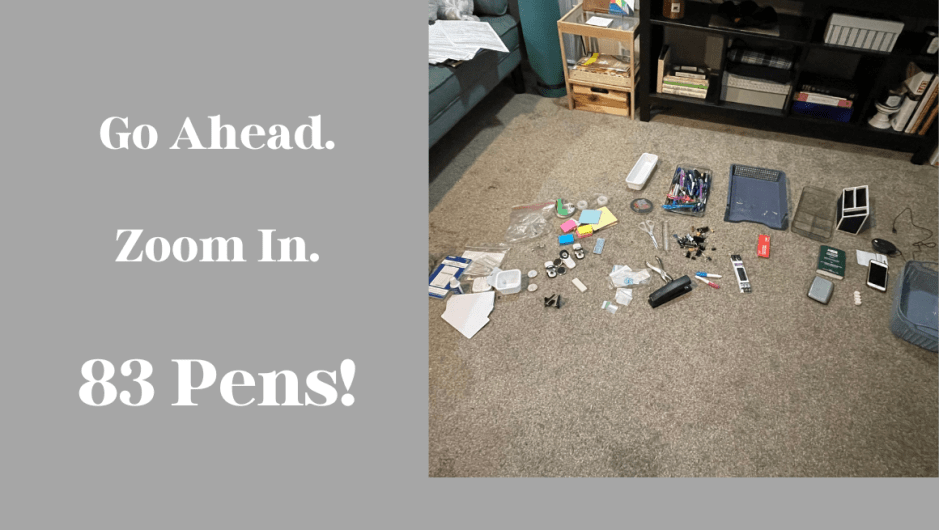
So today, I took another look at the stuff in my desk drawers. The papers, folders, and accessories weren’t an issue. They were all things that I either needed at my workspace, like files, or things that I wanted there, like a favourite picture. I was shocked when I looked at my pens and other writing instruments though. I even checked my work bag and various other spots where a pen might be. I took a deep breath, gathered them all up, went back to the living room floor, and dumped them. I made piles again, to sort types, colours, etc. And then I counted them. 83. Really girl???

34 blue, 12 black, 9 red, 13 other colours, 13 markers and highlighters, 2 pencils

I’d like to stay I carried on and got rid of all the excess items in my desk, including the pens. But I decided to procrastinate and go out for coffee and some writing time. I’ll get back to you later on the pen situation. If I get around to it.

In the meantime, here’s a double whammy of a quote I think I need to puzzle over …

“Clutter is the physical manifestation of
unmade decisions fuel by procrastination”

Christina Scalise, author

“A word after a word after a word is power.”

Margaret Atwood

I Graduated. Again.

CAUTION: Trigger Warning!
This post is about depression and mental illness.
If you are having a mental illness crisis or are suicidal,
please contact a distress line or your area’s emergency phone number.
International emergency phone numbers can be found here.


Today I graduated from CBT. Again. No ceremonial procession. No cap and gown. No degree awarded. Just me and my teacher signing off our virtual chat, while I was in jeans and a hoodie, having been granted the knowledge that my illness was in remission mode. Again.

My illness you ask? It’s mental. It has a name. It’s called depression.

Read more: I Graduated. Again.

I was first diagnosed with depression at the very, very tender age of eight. About 45 years ago. I had experienced some trauma in my life already by that age. The clincher to getting diagnosed was when I told my mom I wanted to “go sleep with the angels.” Not just once but several times, with varying use of words. A child of that age doesn’t know how or have the vocabulary to express that they don’t want to live anymore. That was my way. My mom understood my way and got help for me. Thank you my angelic Mom.

Depression isn’t chronic for all who have the illness. For me, it is. Sadly, more trauma happened in my childhood and youth. I also have the psychological disorder commonly referred to as PTSD – posttraumatic stress disorder. My depression and my PTSD cohabitate in my psyche. More years than not, they are with me quietly in the basement, sometimes they’re present but peacefully in my living room of life, and sometimes they are in my attic, obnoxiously and loudly, bellowing out at for my attention and disrupting my entire existence.

About six months ago, they both completed their ascension to my attic, hand in hand. One day in January, I had both a “new” memory of a trauma that had been repressed since my childhood, and a panic attack, likely triggered by the memory resurgence. Lots of difficult stuff had been going on in my life before that particular day. I simply thought it was high stress leading to physical, mental, and emotional exhaustion. I didn’t see it for what it was: depression. And that for many, including me, is a common symptom of the illness. Every instance that I can recall of my depression coming out of remission has slowly crept up and then blindsided me. This one was no exception.

I’ll be sharing more about my mental illness AND wellness in the future. In fact, it is one of the primary reasons why I returned to writing. Not just for the therapeutic effect it has in my soul. Which is amazing by the way. But also to increase awareness and share resources about depression, suicidal tendencies, anxiety, panic attacks, PTSD, and addictions. Including what I have gained after doing CBT a handful of times now. CBT being Cognitive Behavioural Therapy.

For now, I just want to say I couldn’t have beaten latest occurrence of my depression alone. I am strong, I am smart, and I am brave. I have championed a lot solo. But when it comes to my mental illness, I need others to be givers of care. I need help. On a different day back in January, I uttered the words my depression doesn’t like to say out loud. I called my nurse and said ‘please help me.’ Even that act involved somebody else. She was part of my transition from I to we, my first step to getting better. Again.


“A word after a word after a word is power.”

Margaret Atwood